
Video & Editing · 01 of 04
Cut on the change of intent
Cut when the idea changes, not when the shot goes stale.
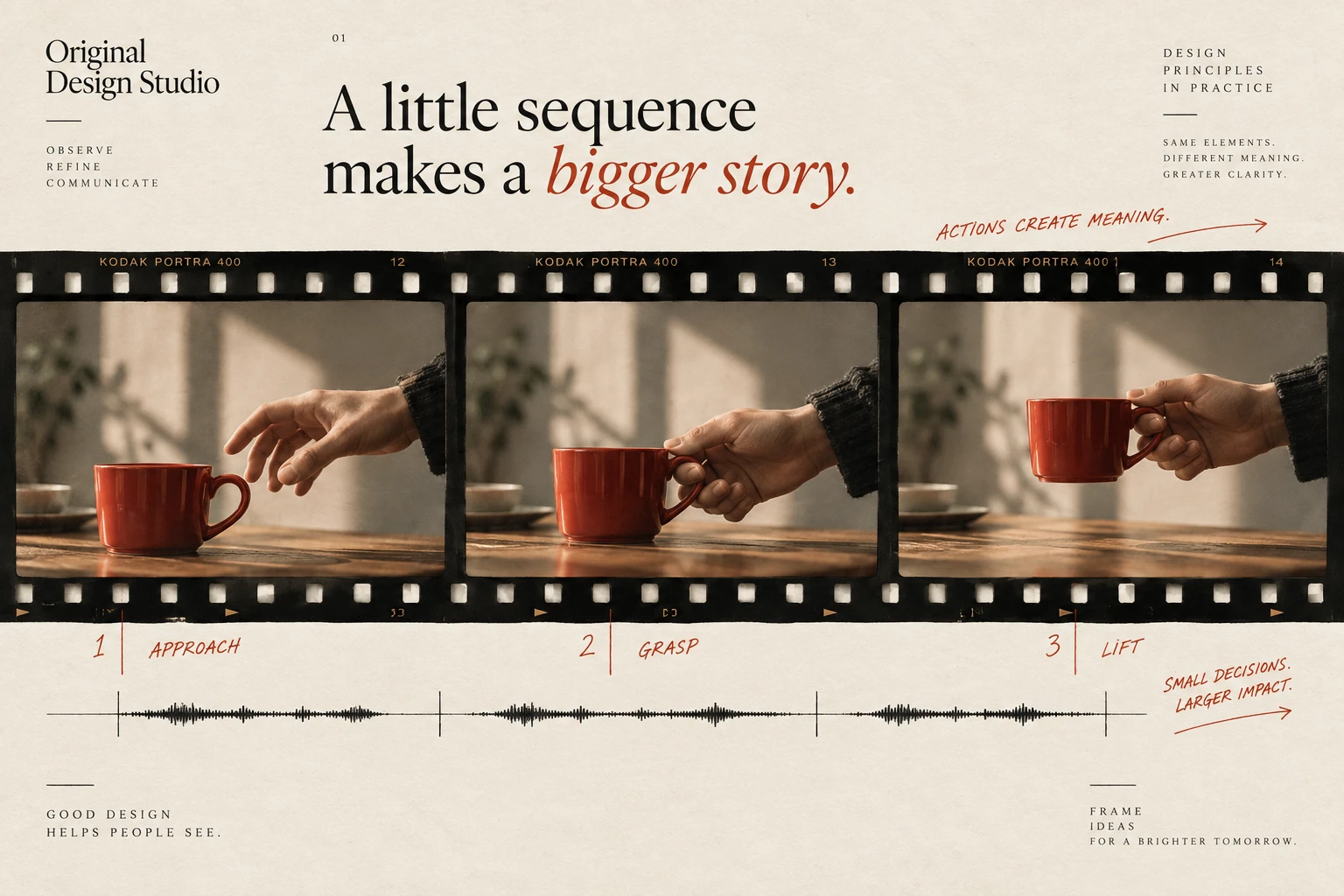
The idea
Change the shot when the next picture gives the viewer something useful.
A cut directs attention. It can reveal a result, introduce a new subject, move closer to a detail or change the emotional meaning of a scene. Decide which of those jobs the next shot performs before choosing its duration. A viewer should have a reason to look at the new picture.
For a product demonstration, think in cause and effect: show the action, allow its result to become visible, then show the detail that proves the change. Cutting away between the action and its result can make a simple process difficult to follow. Holding a shot after its useful information has been understood can be equally distracting.
Write a short sequence of beats before arranging the footage. Each beat should answer a question raised by the previous one. Music can help shape the timing, and a cut on movement can make the transition feel continuous. Neither technique supplies a missing explanation. Review the sequence without the music, then with the full mix.
How to see it
Terms used in this lesson
The parts
- Intent
- The claim this shot is making. When the claim changes, cut.
- Duration
- How long the idea needs. Some need two seconds. Some need eight.
- Seam
- A cut hidden on a movement or a sound, when continuity matters.
- Argument
- The one-page case, written before the timeline is opened.
In practice
- Describe what each shot adds before deciding where to cut.
- Keep actions and their visible results close enough to follow.
- Use movement or sound to connect shots when continuity helps the explanation.
Avoid
- Cutting away before the viewer can identify the result of an action.
- Keeping a shot only to fill a musical phrase.
- Using transitions to cover a sequence whose meaning is unclear.
The test
Mute the music. If the cuts still make sense on picture and speech alone, they are on intent. If a cut has no claim under it, it is pace.
Reviewed against all forty, on your product.
The audit is the cheapest thing we sell, and it regularly concludes that you do not need the project you came for.