

10 / Originality

Provenance

Keep the origin and permitted use of work clear. Record references, distinguish research from reuse and document production decisions and release terms.

Provenance specimen
Principle 1 of 4 · 01Full entry

Keep a useful record of references

The idea

A reference list helps others understand the research behind a project.

Record the original maker or publisher, the work, a link and the aspect that informed your thinking. Distinguish a direct reference from a broad tradition or a competitor comparison.

Keep this record with the project and include relevant references in the handover. Credit is valuable, but it does not itself grant permission to reuse an asset. Track reuse permissions separately where needed, and do not present a source as evidence for a claim you have not checked.

How to see it

A useful reference records the source and the specific idea it contributed.

Terms used in this lesson

The parts

Reference
The work consulted during research.
Attribution
Credit identifying a maker or source.
Permission
The basis on which an asset may be reused, separate from the credit.

In practice

  • Record the original maker and work
  • Explain the relevant design idea
  • Keep permissions separate from credits

Avoid

  • Crediting an aggregator as the maker
  • Losing the references during handover
  • Treating a credit as permission to reuse
Test

Choose a major design decision. Can another person find its reference and understand which idea informed the work?
Principle 2 of 4 · 02Full entry

Learn from the reasoning behind a reference

The idea

A useful reference reveals a relationship between a problem and a design decision.

A tight grid might support comparison; a large image might establish context. Identify that relationship instead of copying the visible treatment without its purpose.

Develop alternatives against the current brief, audience and constraints. Compare the result with the reference to identify unnecessary dependence, while recognising that shared conventions are common. If an actual asset is being reused, handle its permission and attribution explicitly rather than treating a visual change as a substitute.

How to see it

Look for a shared principle with a solution suited to the new brief, rather than a cosmetic variation of the source.

Terms used in this lesson

The parts

Constraint
A requirement or limitation shaping the solution.
Deconstruction
Examining how a reference responds to its problem.
Adaptation
Developing an approach for a different context.

In practice

  • Describe the problem the reference solves
  • Explore alternatives against the current brief
  • Check rights for any reused assets

Avoid

  • Copying a surface without understanding its purpose
  • Changing colours and calling the result independent
  • Using a thumbnail comparison as a legal test
Test

Explain the borrowed idea without showing the reference. Can you show how your design responds to this project's particular content and constraints?

Principle 3 of 4 · 03Full entry

Document generative tools in the handover

The idea

When generative tools contribute to a deliverable, record their role in the production notes.

Identify which assets or stages they affected and who reviewed the result. Agree with the client on any relevant disclosure and production requirements.

Review generated work for accuracy, suitability and the permissions relevant to its use. Check the tool's current terms and the supplied inputs rather than assuming every service grants the same rights. The responsible person still needs to make and verify the final choices. Keep the production record where the project team can find it.

How to see it

A concise production note identifies the tool's role and the person responsible for review.

Terms used in this lesson

The parts

Production record
A description of how the deliverable was made.
Reviewer
The person responsible for checking the output.
Scope
The assets or stages to which a production note applies.

In practice

  • Keep production notes with the project
  • Identify the human reviewer
  • Check relevant tool and input terms

Avoid

  • Misrepresenting how work was produced
  • Shipping output without review
  • Assuming all generative tools share the same permissions
Test

Can the project team explain how each delivered asset was produced and who reviewed it, without reconstructing the process from memory?

Principle 4 of 4 · 04Full entry

State the terms of reuse

The idea

If you intend others to reuse a resource, choose terms that match that intention and the rights you hold.

Different licences permit different uses. Read the actual licence and link to it rather than relying on a phrase such as free to use.

Separate your own material from third-party assets with their own terms. A licence on the project does not automatically cover everything included in it. For client deliverables, document the agreed rights and handover scope in the appropriate agreement. Keep those details consistent with any public release.

How to see it

A clear statement of terms helps a recipient understand the intended reuse. Link to the full applicable licence.

Terms used in this lesson

The parts

Licence
Terms granting specified permissions to use material.
Scope
The material and rights covered by those terms.
Third-party asset
Material supplied by another rights holder that may have separate terms.

In practice

  • Link to the applicable licence
  • Identify separately licensed assets
  • Document the scope of the release

Avoid

  • Vague permission statements
  • Licensing rights you do not hold
  • Assuming a project licence covers every included asset
Test

Can someone identify which licence applies to the file, what it covers and where any separate asset terms are recorded?

Provenance, in practice

View full size ↗
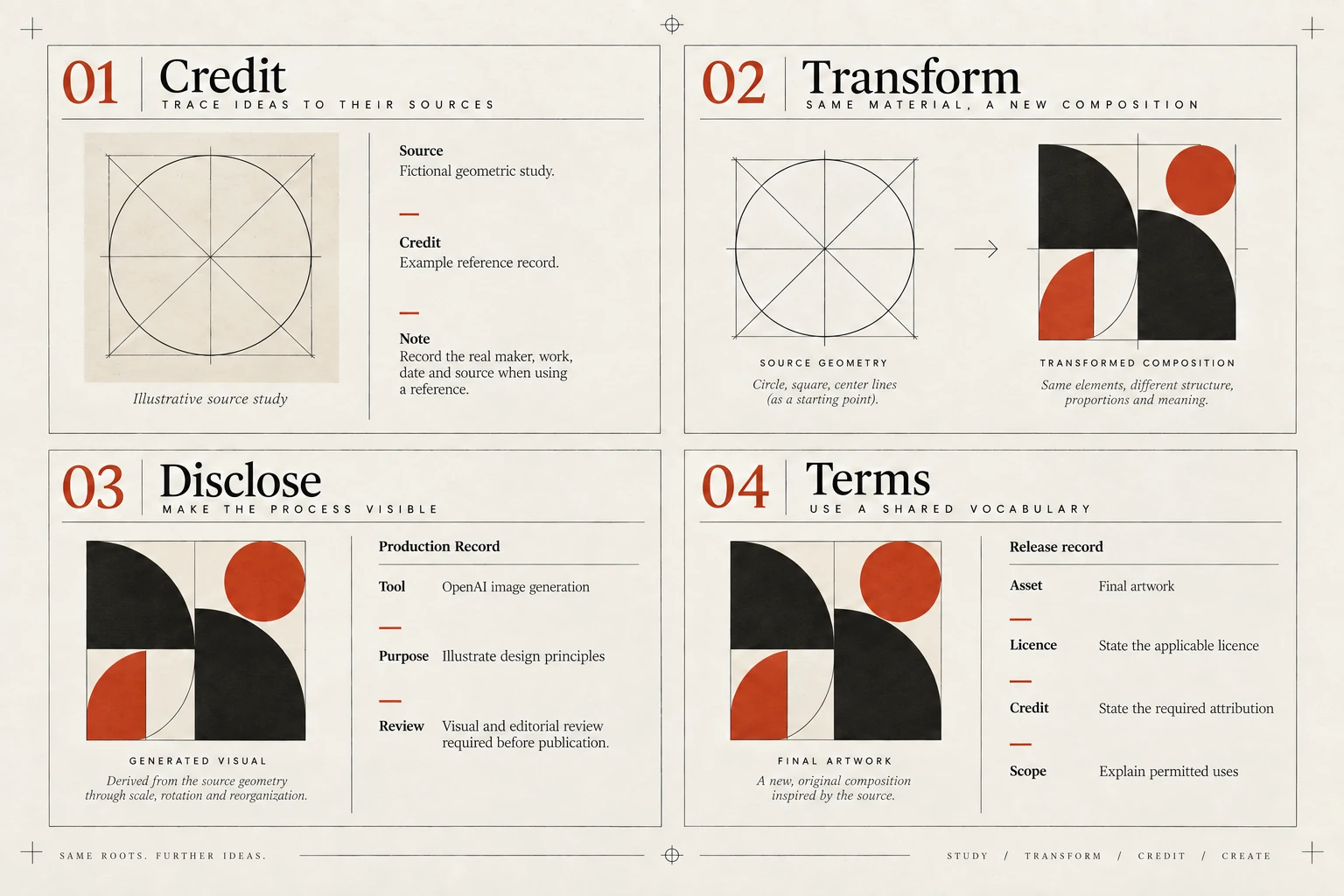
Four visual examples of provenance: keep a useful record of references; learn from the reasoning behind a reference; document generative tools in the handover; state the terms of reuse.

Four principles at a glance

  1. 01

    Keep a useful record of references

    Name the work that informed a decision and explain what you learned from it.

  2. 02

    Learn from the reasoning behind a reference

    Understand the problem a reference solves before applying its approach.

  3. 03

    Document generative tools in the handover

    Keep a clear production record and a named person responsible for review.

  4. 04

    State the terms of reuse

    Make it clear what others may do with the material you release.

Apply it

Score your work against this discipline.

An audit reviews what you have shipped against all ten disciplines, tested with assistive technology and on real hardware, and returns a prioritised plan.